
CLAY TARGET SHOOTING
The sport of Clay Pigeon Shooting involves using a shotgun to shoot at and break a circular flying target made from a fragile material.
Clay Pigeon Shooting has evolved into a sport enjoyed by a wide range of ages (often from ten years and upwards) at all levels from novice to Olympic competition. Safety is a priority at all shooting grounds with a firm set of safety rules being applied by all those involved.
The Clay Pigeon
A Standard clay pigeon is an upside-down saucer shaped disk, 110 mm in diameter and made from a mixture of Calcium Carbonate (Limestone) and Pitch. Clays come in several shapes, sizes and colours to allow a wide variety of targets to be thrown against both light and dark backgrounds.
Types of Clay Targets
Standard (108mm-110mm): The most common, versatile target used for, this is a general purpose target and this is a general purpose target on most of the clubs.
Midi (90mm): Smaller and faster, these simulate distant, quick birds and are harder to hit.
Mini (60-70mm): Extremely small and fast, used for advanced training.
Battue: Thin, flat discs that fly straight, then suddenly drop or dive.
Rabbit: A thick-rimmed disc designed to roll along the ground. That mimic’s rabbit’s run, hence “RABBIT”
Specialty/Coloured: Used for better visibility against backgrounds.
The sport of clay target shooting originated as a way for hunters to maintain their marksmanship out of season. Targets, which these days are saucer-shaped discs of breakable pitch or ‘clay’, are thrown in varying trajectories, distances and speeds, with the shooter scoring points for each target they hit. The targets are sturdy enough to be thrown at speed from launching mechanisms, called traps, but are brittle and will break upon impact with shotgun pellets fired at them – sometimes with spectacular results.
Over centuries, the sport has developed and diversified into several disciplines, and it’s not just hunters that take part. Field & Game Australia has members who don’t hunt, but are keen clay target shooters. It’s a great way to socialise with family and friends; to have fun; and to benefit from the personal growth and discipline that comes with participating in any sport.
There are three main types of clay target shooting: simulated field, skeet and trap.
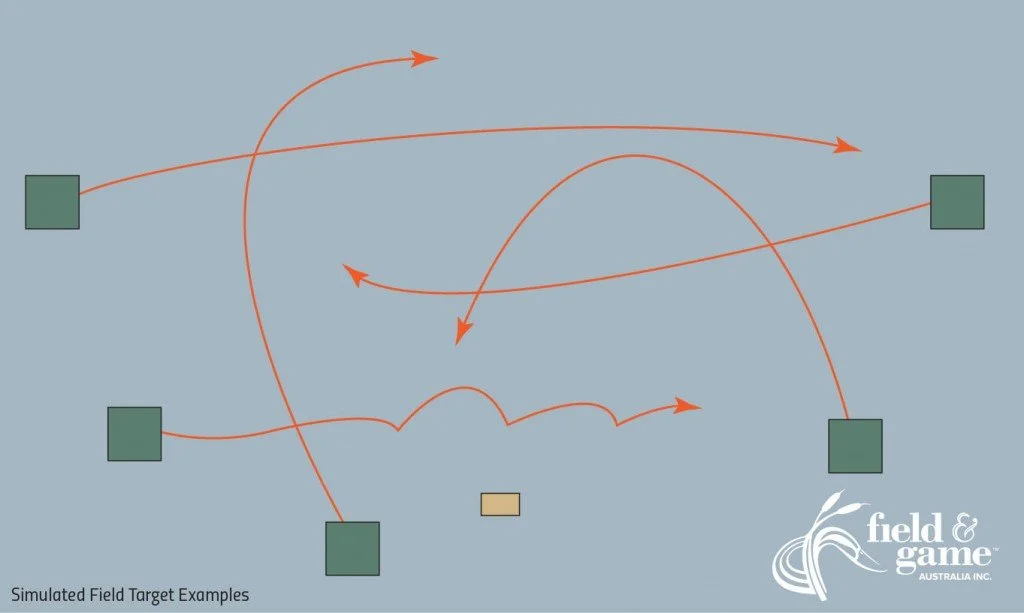
Simulated Field is the general term used for disciplines where targets are thrown to emulate the movements of game animals, as such, there are no set trajectories or shooting stand layouts for most Simulated Field events. Field & Game Australia’s discipline for Simulated Field is referred to as Australian Simulated Field, and is the most popular discipline of clay target shooting at Field & Game Australia ranges.
Simulated Field targets can be thrown from all sorts of positions, with all sorts of trajectories. Shooters will never experience the same set of targets twice, even at the same Field & Game Australia range. As they are emulating game animals, variation and diversity is key for a set of good simulated field targets. This same variation and diversity keeps the sport interesting.
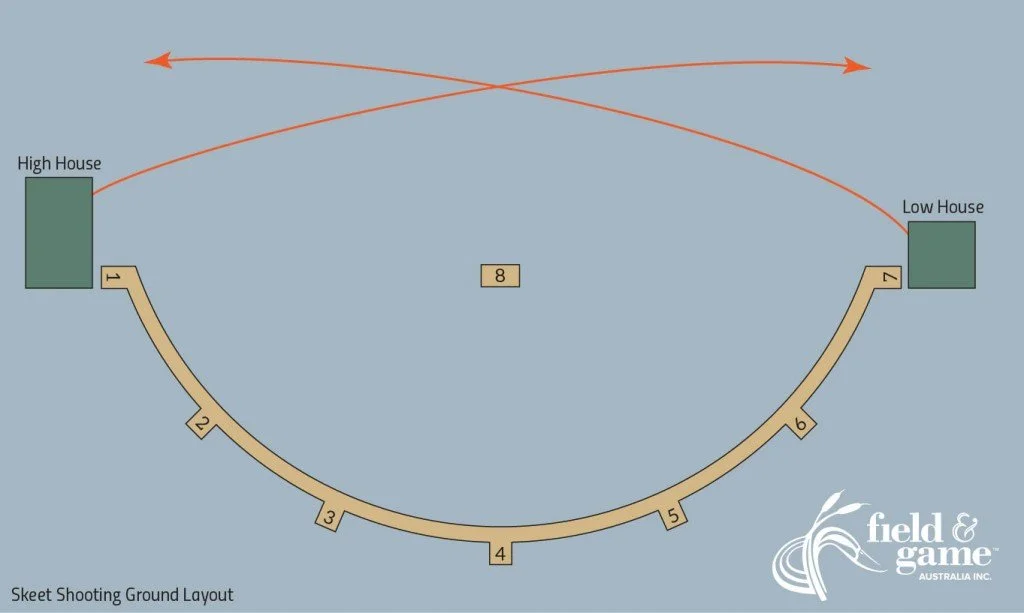
Skeet shooting is where targets are thrown from two separate towers, one high and one low, on set trajectories. Each target thrown from each tower will be the same, but the shooter changes position, moving around a semi-circular course with set shooting points. Skeet grounds, and skeet targets, will be very similar, if not identical, the world over.
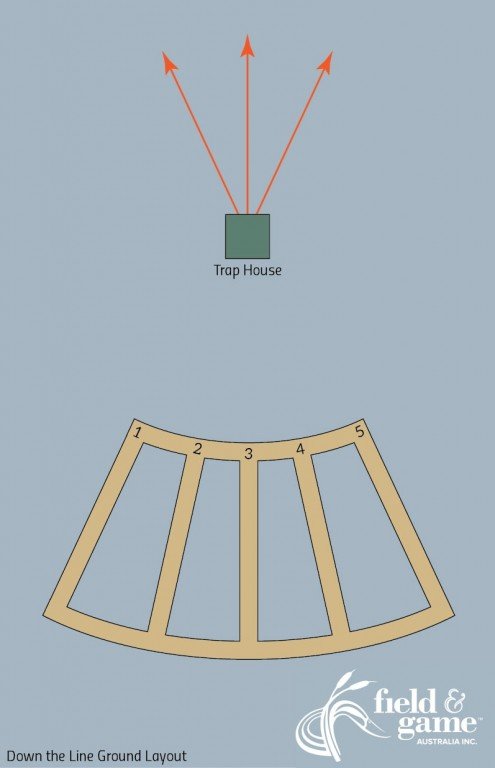
Trap shooting has a few different types, and includes the single and double trap variants featured at the Olympic Games and other international sporting competitions. The trap variant most likely to be run at Field & Game Australia branch shoots is Down the Line.
Down the Line has five shooting stands arranged in an arc, with the trap house located in front of the shooting stands. Targets are thrown from this central trap house, moving away from the shooting stands within a defined arc. Shooters move between the stands after each round of targets, rotating between the five set shooting points. Down the Line grounds and targets may differ slightly from place to place, but are essentially the same.
From time to time, Field & Game Australia branches will hold other types of shoots, with other variants of Simulated Field. Novelty shoots are also popular, especially for events held by our branches to raise funds for local community causes, or the annual Christmas break-up shoot.
Who Can Shoot
Clay Pigeon Shooting can be enjoyed by a wide range of people. There are however limitations on age and gun licensing as described below:
Age limits
Shooters as young as ten can take part in clay shooting, but small children will find a shotgun heavy. Lighter guns, such as a 20 gauge, are available but it is advisable to start all new shooters off with professional tuition. A bad experience with recoil, due to poor gun mount, can leave a young shooter with a bruised shoulder and a reluctance to shoot again.
Upper age limits are irrelevant. As long as you can see the flying clay, control a shotgun throughout and be safe to everyone around you (including yourself) you are welcome to give it a go.
If you have any other inquiries or about coming to the club and giving it a go, please see contact information below and get in touch with us.